
Data Transparency in the New Nepal
21 December 2018
Now that it is a federation, is this the opportune moment to institutionalize open data practices for local governments?
By SAROJ BISTA, KATHMANDU, NEPAL
Since 1991, Nepal has had special laws relating to the opening of government information and the right to information. Since devolution, however, it is critical to think about how 753 local governments can also advance transparency. Such local units are new and might lack the know- how for practicing and institutionalizing transparency. Open data can only be prioritized after ensuring that the governments have proper skills to collect and manage their data and use them for decision making. For that to happen, efforts from various stakeholders, including federal government, international actors, champions of open data and transparency, and local organizations, are required. These local governments could be appropriate platforms for piloting innovative ideas for creating an impact as well as showcasing them.
Nepal: On a journey from Unitary to Federal System
Nepal is a land-locked and seismically active country that saw 12 years of armed conflict from 1994 to 2006. There were also a number of political transformations in the 60 years preceding the creation of the federal system, with the century-old Rana oligarchy ending in 1950, the active monarchy (Panchayat System) in 1990, the constitutional monarchy in 2006, and finally the democratic republican system in 2015.
In spite of these changes, there was no change in the unitary statecraft characterized by very little or limited power devolved to the local level.
On September 20, 2015, Nepal took a huge leap from a unitary to a federal system, transforming from a system with 5 Development Regions, 14 Zones and 75 districts under direct operation from central government to the current system of 1 federation, 7 provinces and 753 local governments (including 6 metropolitan cities, 11 sub-metropolitan cities, 276 municipalities and 460 rural municipalities).
Most importantly, this time, the reconstruction came together with devolution of power by the new Constitution. For the first time in the history of Nepal, the local governments have been given significant power, including:
- Local taxes (wealth tax, house rent tax, land and building registration fee, motor vehicle tax, service charges, tourism fee, advertisement tax, business tax, land tax [land revenue], penalty, entertainment tax, land revenue collection)
- Management of the local services
- Collection of local statistics and records
- Local level development plans and projects
- Local records management
- Management of Village Assembly, Municipal Assembly, District Assembly, local courts, mediation and arbitration
- Local roads, rural roads, agro-roads, irrigation
- Distribution of house and land ownership certificates
- Management of senior citizens, persons with disabilities and the incapacitated
- Collection of unemployment statistics
- Disaster management
(a full list of powers can be seen here)
The local government’s stake in economic, socio-cultural and environmental development within its jurisdiction has indirectly provisioned the establishment of an Integrated Service Centre to facilitate public service delivery more conveniently.
Now is the Time for Data
As the local governments start exercising their powers and authorities, they will start producing data of various kinds, meaning that More Work = More Data. The data from civil registration (birth, death, marriage, migration etc.), education, health, demographic surveys, enterprises, environment protection, taxes, and projects while exercising the powers and duties conferred to by the Constitution constitute a huge amount of data. At the administrative end, they also produce data involving municipal council decisions, monitoring reports, etc. In fact, each local government can exist as a significant government data-holder. Various other actors working in local governments have also been producing large datasets (health, education, demographic studies, natural resources, etc.).
As a result, this presents an opportunity to kick-start collection and utilization of data. As a fresh beginning, data at the local constituencies can play an important role by establishing the baselines that were previously only roughly set. Also, simple yet proper analyses of existing data can sometimes surprise us and influence decision making.
Example I: Development of Infrastructure Management System (IMS)
YoungInnovations did a quick exercise with 21 major infrastructure projects in Dhangadhi Sub-Metropolitan City following the interest of elected mayors to monitor their status and progress (physical and financial). Received were some data in various formats and arranged it to resemble the Open Contracting Data Standards (OCDS) more closely. We then came up with a visualization. The elected representative was able to see:
- Physical status of the projects, i.e., physical progress achieved by the contractors as well as user committees measured against the milestones set forth in the contract.
- Financial expenditure, i.e., the contracted amount disbursed.
This facilitated the representative’s ability to see the statuses (i.e., completed, pending and underperformed projects with potential red flags).
This quick exercise established that data are primarily helpful for newly-elected local government representatives to be able to quickly learn the statuses of the development projects within their constituencies. It fascinated the mayor and other representatives. The visualization can be seen below.
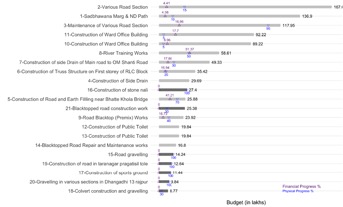
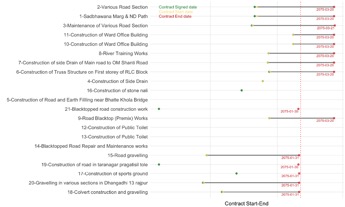
A simple monitoring tool based on expectation of the mayor to monitor projects now looks like this.
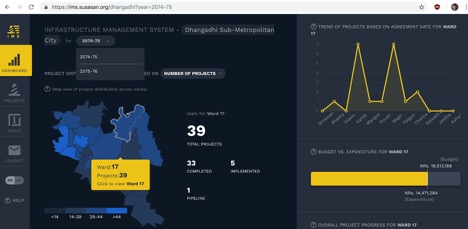
The system captures approximately 760 projects from the past fiscal year and over 400 projects from the current fiscal year along with their statuses. The platform is not only useful for municipal officials (i.e., engineers who can incorporate it into their existing workflow and monitor the progress of projects) but also provides spaces for citizens to submit their feedback regarding issues such as an apparent delay in completing the works, quality of works etc. There is a simple mobile application where the general public can see the list of projects along with their progress data and provide feedback with photos as evidence.
As seen in the example above, data is a powerful tool that can be used to create an impact backed by the quantitative facts and evidence rather than qualitative information. Data can not only help to see the current status but also help define the next steps necessary to improve upon the current status. Furthermore, it can help validate the decisions made.
Opportunity to become the first of open local governments
As no benchmark has been set, each local government has a chance to become one of the first local governments of Nepal to set the foundation for the adoption of open governance practices. They can also choose to continue this work with the exploration of many other scopes where analyses of data and information could add a value to the functions of local governments. This would definitely enable the governments to provide better services to their citizens, backed by science and facts instead of assumptions and perception of individuals.
Example II: Exercise with Existing Data to Develop Data Portal
YoungInnovations engaged with officials of Sanfebagar Municipality and exercised with data produced by Municipality in a span of a year mainly focusing on the decisions of the municipal council, policies and plans, development programs, budget, tax-related information, generic profile, and points of interest. That resulted in the development of a Municipal Information Portal for the Municipality. (You can learn about the celebration of International Open Data Day 2018 in Sanfebagar Municipality here).
Enablers
As of now, there are several enablers for ensuring public access to data which allows space for scientific management of data and information.
For example, the Constitution of Nepal 2015 prioritizes the use of information technology in order to ease the public access to information. The Constitution provides a scope to ensure the general public has easy and simple access to information technology by developing and expanding information technology.
Importantly, the policies of the Government are oriented towards operating a single Electronic Government Procurement (e-GP) platform for ensuring fairness in public procurement. This is applicable to all of Nepal’s public entities that use the system while procuring goods, services or works. This is legally ensured with the amendment in Public Procurement Rules 2008 that states the procedure to establish, operate and manage a single e-procurement system by the Public Procurement Monitoring Office (PPMO).
In 2016, the PPMO entered into a Memorandum of Understanding (MoU) with The Open Contracting Partnership (OCP) to publish procurement data into OCDS. The beta data portal can be seen here. Progressively, in 2017, PPMO set a guideline regarding the operation of the electronic procurement system to establish a unique system, a link of interconnectedness with the electronic procurement system in order to ensure that everybody has access to the detailed public procurement information.
The largest chunk of public spending is consumed through the procurement of goods, services and works. Therefore, making the procurement data available can have a huge impact in ensuring key use cases, i.e., value for money, checking frauds and corruption, market fairness and effective service delivery. Furthermore, standardization and publication of such data ensures that the data are structured properly and disseminated.
Next Step I: Data First…then Open Data
It can be seen that the local governments are sensitized to ensure the transparent functioning of the government, hence disclosing data/information. But the accompanying question is whether the data contained in unstructured formats are being used. Or, is the data useful for governments to inform some decisions or can they be used by the government to induce some contractors to accomplish the projects within set deadlines. On the other hand, another question is whether the public-at-large is benefitting from the data that are published.
At this time, it is seemingly unrealistic to introduce open-data as a major priority for the local governments in Nepal as they are still lacking in appropriate human resources, equipment and technology. Rather, the primary focus should be on managing data.
While reviewing several types of data contained in the municipality, we realized that most of the data existed in non-structured formats, i.e., mainly print-outs (hard copies) and pdf.
Hence, data management should be prioritized in order to systematically receive, store and disseminate data. Gradually, local governments should work towards making data available to the public in an open format.
Next Step II: Engage with local government, offer support
We understood that engagement with the representatives of the local governments as well as IT personnel is another major action that is required. It is imperative that we start to transfer knowledge and skills to them as soon as possible. This helps to ensure that the intervention continues to sustain and improvise beyond our support.
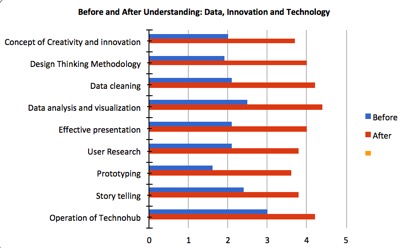
YoungInnovations brought together 12 IT personnel from local government along with some civil society members, for a four-day in-depth discussion about government data, its processing and how it can inform decision making. The intent was to talk about the importance of data as such, in decision making and impact creation in local government. A recount of the event can be read here.
The response of the participating IT officials in terms of understanding was quite motivating.
Why Act Now?
If we are concerned with helping local governments to become more open and accountable, this is the appropriate time to engage with them.
- It would provide opportunity for local governments to generate ideas and pilot them to assess whether they are suitable to create impact. There will be room to revise and scale-up the ideas and/or replicate them in other places if piloted effectively.
- Local governments welcome newer ideas and also offer support to the extent possible. If the approach is clearly explained, they often adopt them.
Project SUSASAN is being implemented in 12 local governments of Nepal as a pilot to ensure sustainable use of technology for public sector accountability. A number of local governments created mutual fund to share costs of project activities including technology setup, data collection, surveys, mapping of points of interest etc.
- There are several civil society organizations doing great work at the local level that have built a very good rapport with local governments. This is one of the enablers where knowledge and skills can be transferred both to the governments as well as such organizations so as to ensure the effectiveness/impact of the intervention.
- While we are talking about creating impact through our intervention, beginning with local units is the best idea. It is practicable that we measure the impact of everything that we do, provided we have clearly defined intervention with specific objectives. Then there will be good stories of impact coming out of Nepal to share it among a wide variety of stakeholders. Such stories could be useful for others who are also working to bring open data practice from the ground up.
These points, coupled with the transition period Nepal is currently undergoing, place the country in a prime position to make innovative strides in governance. It is large and active enough to produce a rich amount of data, and the recent devolution has created their best opportunity yet to improve data management and eventually data publication strategies within the municipalities. A successful move to a more open government would be a fairly manageable lift and could yield a substantial impact. For this, Nepal should be considered a top candidate in the list of countries where experiments with opening government and leveraging government data should be attempted, and the lessons learned from their experience could be valuable to nations that are planning to pursue similar objectives.
– Saroj Bista with the help of Samuel DeJohn, Rakesh Pradhan and Timi Lewis
*YoungInnovations is a Kathmandu based tech company founded in 2007, specializing in solutions for development and working to establish open data as one of the priorities of the Government of Nepal. For 11 years, it has been working internationally and domestically with partners who are trying to create change in the world with data as the heart of the initiatives. It has been leading the OpenNepal initiative here in Nepal, has worked with the Government of Moldova and the Government of Nepal to build their Open contracting portals, has developed a product called AidStream to help organizations around the world publish their data to IATI Registry, and has been involved in many more projects to support the use of data. In recent years, YoungInnovations has been working closely with a few local governments to help them institutionalize data transparency and ensure effective service delivery and grievance redressal through sustainable use of technology through the SUSASAN Project.
