
The GovLab @ TransparencyCamp 2014
27 May 2014
Started by the Sunlight Foundation in 2009, TransparencyCamp brings technologists and policy-makers together to discuss obstacles to transparency and ways to implement innovative transparency policies in governance. TransparencyCamp takes the format of an “unconference” for open governance –a participant-driven event where participants create the agenda at the beginning of the meeting.
This year, TransparencyCamp will be held from Friday, May 30 to Saturday, May 31 at George Mason University School of Public Policy, in Arlington, Virginia. Several session ideas have already been submitted for consideration to be included in the TransparencyCamp agenda, such as:
Bringing Government Data to Life
- This session proposes to use open-source tools to “sort, filter, and visualize” raw U.S. government data sets so as to turn them into “easily accessible research tools”.
Opening Government with Human-Centered Design
- This session proposes to use the process and techniques of “human-centered design” to find solutions to social and societal problems.
#OpenGovNow: Innovations on Gathering Citizen Feedback
- This session proposes to explore the value of using emerging tools to gather “citizen-generated data in real time” and for participants to “identify areas where citizen feedback could add the most value”.
The GovLab @TransparencyCamp:
- See the GovLab’s Session Proposal: Populating an Open Tech-Policy Dictionary
Over the course of the GovLab’s work in the field of technology policy, we’ve noticed there are major barriers to progress that exist because of differences in the jargon and terminology used by technologists versus policy-makers. While policy-makers often lack an in-depth understand of technological processes and infrastructure informing policy, technologists are often unaware of the laws, regulations and other governance structures governing communications technologies.
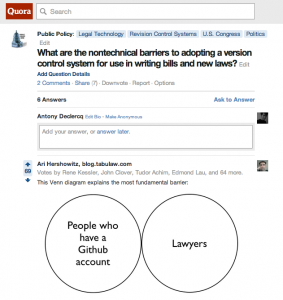
The GovLab team has proposed to run a session to build out an initial set of concepts and their definitions that are used by technologists and policy-makers. Through this brainstorming session, we hope to populate an online Open Tech-Policy Dictionary, to be launched at TransparencyCamp. Imagine it as an Urban Dictionary for the open government movement. For example, when policy-makers use terms like “crowdsourcing” or “privacy”, they tend to use them in ways that do not take into account their meanings in technical terms, and likewise technologists use “crowdsourcing” and “privacy” in ways that do not acknowledge policy-contexts.
Additionally we hope to include other terms whose definitions are less controversial, to give both sides a broad overview of technology concepts like “packet switching,” “structured data” or “servers,” or policy terms such as “stakeholders,” and “participatory governance.”
To help brainstorm definitions for these and any other terms, we will ask TransparencyCamp participants to self-identify whether they are a “policy” or “tech” person and work together to craft definitions. What we learn from the session will contribute to a version 2.0 of the prototype the GovLab plans to build out and house in the GovLab Observatory.
If you plan on attending TransparencyCamp, we would be delighted to have you join us!
How Can You Follow Along and Get Involved?
- Please vote for the GovLab’s session, Populating an Open Tech-Policy Dictionary! The more votes we have, the more attendance we will get and the more likely we are to get meaningful results.
- The GovLab team members that will attend TransparencyCamp 2014 and their Twitter handles are:
- Robyn Caplan – @RobynCaplan
- Luis Daniel – @LuisDaniel12
- Antony Declercq – @AntDeclercq
- Kirk Hovenkotter – @KHoven
- Jillian Raines – @Jillian_Raines
- On the days of the conference, you will also be able to follow the sessions through the TransparencyCamp live Hackpad by clicking through the TransparencyCamp Schedule.
- The Twitter hashtag for TransparencyCamp is #TCamp14. Using the #OpenGov hashtag is also encouraged!
- Sunlight Foundation has more resources about government accountability and transparency, as does GovLab’s Wiki .
- Please also see the archive of previous TransparencyCamps!
