
The GovLab Launches the Tech-Policy Dictionary at TransparencyCamp 2014
12 June 2014
Members of The GovLab team attended the Sunlight Foundation’s TransparencyCamp “unconference” in Washington, D.C. on May 31 and June 1 (see our blog post from before the event, The GovLab @ TransparencyCamp 2014). TransparencyCamp brings together open government advocates and practitioners from around the U.S. and the world for two days of interactive sessions, collaboration, and networking. It’s goal is to help “people gather to share their knowledge about how to use new technologies and policies to make our government really work for the people—and to help people work smarter with our government.”
See Sunlight Foundation’s post regarding the highlights of TransparencyCamp 2014.
Our GovLab Session: Presenting a Tech-Policy Dictionary
“With open data projects, it’s almost never a technology problem, but a communication problem.”
-A recurring statement at TransparencyCamp 2014.
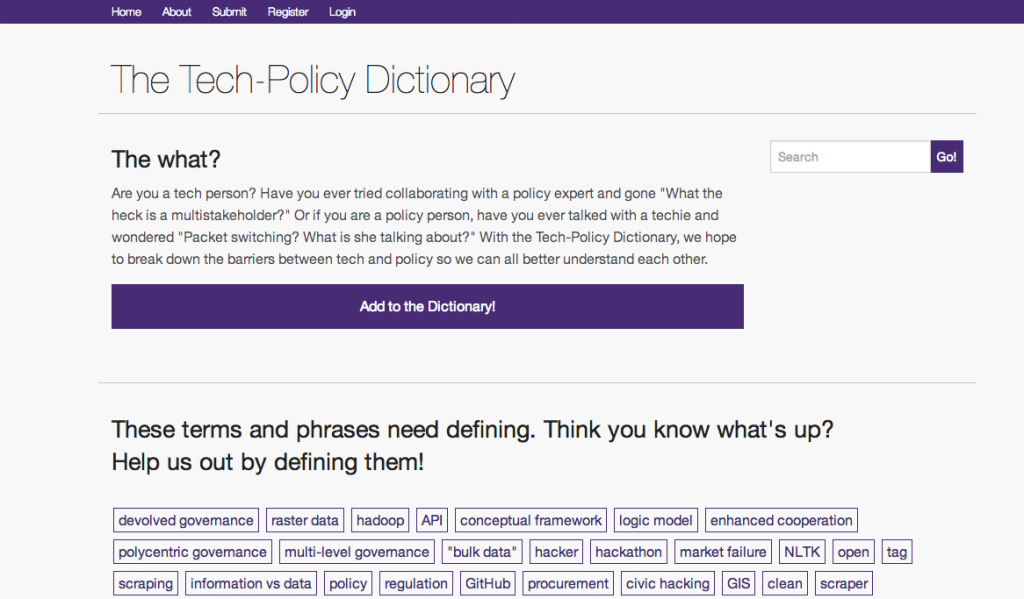
Our GovLab team had the privilege of leading a session about how to break down communication barriers between the policy and tech communities. Specifically, we presented a prototype version of a crowdsourced online dictionary or guide that we created, the Tech-Policy Dictionary (TPD). The TPD aims to help both the tech and policy communities build clarity and understanding of terms and concepts frequently used by both communities, but often not used in common by all.
We presented our TPD prototype as an “Urban Dictionary for the open government movement.” The site allows users to submit terms and/or definitions for terms, and vote up and down definitions. The goal of the TPD is to build a guide for the open government community that we can all help to evolve over time through user-contributions.
Our aim is not necessarily or exclusively to foster consensus-building around one, right meaning of a term or concept; rather, we hope that the interaction of technologists and policy-makers through submitting and voting on the TPD will increase shared understanding and allow both communities to see which words, phrases or concepts have the most and the least agreement around their meanings.
Contributions from the TransparencyCamp community
The session proved extremely useful. We received a great deal of feedback and suggestions for how the TPD can develop going forward. In particular, we heard many ideas regarding how a set of crowdsourced terms can be used or employed in different contexts to allow technologists and policy-makers to better understand each other and work more efficiently and effectively. Some key ideas we heard include:
- Enable other languages in the dictionary. Some participants noted that many open government terms lack translations in languages other than English.
- Tagging/linking like terms. This would enable creation of a “tag cloud” to document relationships between like terms.
- Ability to discuss/comment/collaborate through the site. Participants suggested it would be useful for dictionary-users to be able to discuss terms and their definitions with each other through the TPD.
- Ability to cite definitions. Participants suggested that definitions also be cited with examples of how they have been or could be used: in sentences, in documents, etc.
- Storytelling capacity. Participants suggested the ability to provide analogous terms and concepts within the definition of a term, along with the ability to include pictures or videos to show how a term is used in context.
- Audience or context-specific definitions. Participants suggested that terms be defined for specific audiences or contexts, for example a term might be defined differently for a politician as compared to the Chief Technology Officer of a business. It may also be used differently depending on where you’re using it, e.g., in a presentation to government officials vs. a meeting with private sector tech experts.
- More ways to log in. Participants suggested that we link the TPD to users’ social media profiles, for example on Google+, Facebook, and/or Twitter. Participants also suggested that users be able to provide a greater range of information for their profiles, including the organization(s) where they work.
- APIs for the TPD. Participants suggested that we build an Application Programming Interface (API) for the TPD to allow the TPD to share its content with other websites and applications, for example Twitter and Facebook.
- Weekly Twitter word battles. Participants suggested that, every week, one to-be-defined term is chosen from the TPD for Twitter users to define and publicly debate.
- Renaming the Tech-Policy Dictionary. We all agreed that “Tech-Policy Dictionary” itself sounds like technology/policy jargon. We need a better name, which session participants suggested we find through a crowdsourced process. (Feel free to share suggestions with us via Twitter @TheGovLab, using #TPDefined.)
Below is the Storify of tweets about the TPD we collected during TransparencyCamp:
Check out tweets about the Tech-Policy Dictionary from #TCamp14! https://t.co/gv9K2qUHyo cc @TheGovLab
— Antony Declercq (@antdeclercq) June 12, 2014
What’s next?
From these initial suggestions, we think that the TPD has potential to become an important resource for people working in the open government space. It could, for example, be useful for open gov practitioners to help prepare them for speaking to specific audiences about specific topics and increase chances of shared understanding. We also hope that the TPD will be expanded and improved upon by the community. We encourage people to reach out if they want to collaborate as we move forward and we also encourage the build-out of the TPD by others into their own websites and applications. The code for the TPD is on GitHub and we invite anybody to tinker with it and create additional features.
The GovLab also invites all who are interested to submit their own words and definitions to the TPD. The more terms and definitions the TPD contains, the more valuable of a resource the TPD becomes and the more we can iterate on how to make the TPD as useful a tool as possible. To kickstart further discussion, the GovLab challenges readers to define the word “Expertise” – a term that technologists and policy-makers often use to mean different things.
Submit your definitions to the TPD entry for Expertise!
